Where the Sun-Drenched Hills Whisper: A Journey Through Tuscany’s Timeless Embrace
Amidst Cypress Sentinels and Vineyard Veils, Unraveling the Silent Stories of a Land That Cradles Memory in Its Golden Light
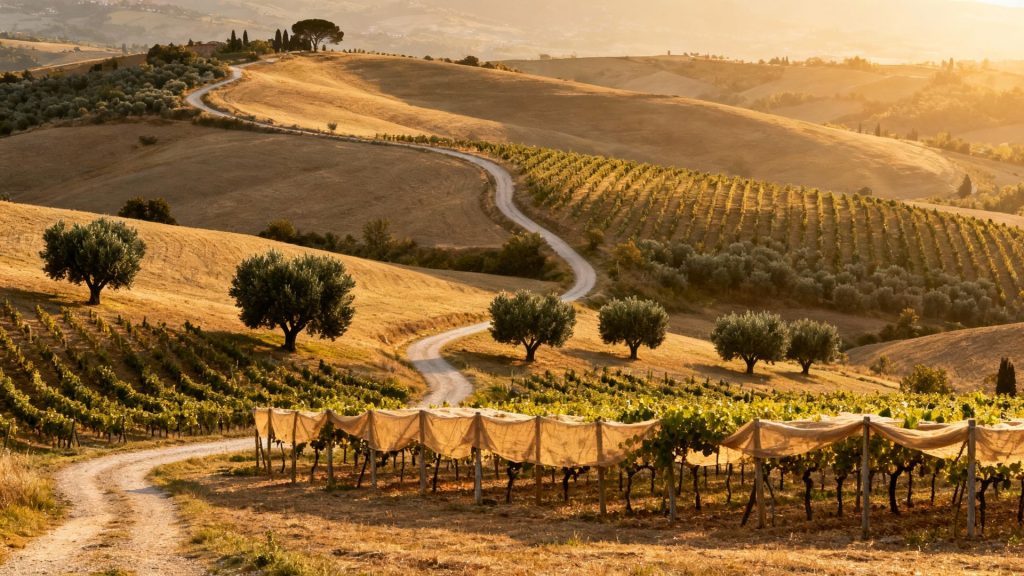
Dawn breaks over the rolling hills like liquid gold spilling across velvet folds, illuminating the precise geometry of vineyards stitched into the earth. The air carries the damp perfume of turned soil and ripening Sangiovese grapes, a fragrance so potent it lingers on the tongue. Somewhere below, a lone farmhouse of honeyed stone emerges from the morning mist, its terracotta roof tiles glowing like embers in the newborn light. This is Tuscany awakening – not with clamor, but with the patient rustle of olive leaves in the breeze, a landscape breathing itself into existence.
Follow the cypress alleys that pierce the horizon like dark green spears, guiding travelers through valleys where time dissolves. These sentinel trees frame vistas of wheat fields shifting from emerald to molten amber with the seasons, their colors deepening as the sun arcs westward. Stone farmhouses cling to hillsides, their ochre walls bearing the patina of centuries, each crack and crevice mapping generations who shaped stone to shelter. At midday, when light turns the land into a mosaic of sharp shadows, the very stones seem to radiate stored warmth, whispering of hands that laid them block by block, adapting architecture to the contours of the earth.
The rhythm here is written in agricultural cycles, not minutes. Ancient Etruscan drainage channels still vein the earth beneath vineyards, their engineering echoing in modern winemakers’ reverence for terroir. In hilltop villages like San Gimignano, medieval towers stand as stone diaries, recording how communal wells became gathering points where gossip and grape harvest predictions intertwined. Observe the chapel frescoes in Montepulciano’s backstreets – not as religious artifacts alone, but as visual hymns to the light that bathes these hills, a luminosity so pure it seems to consecrate the landscape itself.
Return at vesper when the sun bleeds into the horizon, transforming vineyards into rivers of burgundy shadow. Autumn arrives with woodsmoke curling from chimneys and forests blazing in pyres of ochre and crimson. Winter brings silver mists that erase boundaries between land and sky, leaving isolated cypresses as ink strokes on rice paper. Come spring, poppies ignite the hillsides in scarlet explosions, their fleeting brilliance a reminder that beauty thrives in transience. Each season rewrites the landscape in a dialect of color and texture, yet the essential character remains – that of a patient guardian cradling memory in its folds.
To experience Tuscany is to surrender to sensory archaeology. Run fingers along sun-warmed limestone walls in Pienza, feeling the granular history of seabed fossils embedded within. Taste new-pressed olive oil so peppery it makes the throat catch, its green-gold hue mirroring the hills that birthed it. Sit on a stone bench in a hidden cloister garden, listening to bees drone among lavender as church bells measure the hours. These moments bypass intellect to resonate in the marrow, awakening ancestral memories of harvests and homecomings. The landscape becomes a mirror reflecting not just what lies before the eyes, but the unspoken narratives we carry within us all.
There’s a particular quality to Tuscan twilight when the last light gilds the hill towns, turning them into floating islands of gold above indigo valleys. In that luminous suspension, past and present merge. The scent of wild fennel crushed underfoot could be from yesterday or a century ago; the view from a monastery garden remains unchanged since Renaissance eyes contemplated it. This is where nostalgia is not described but discovered – in the way shadows pool in ancient stone troughs, in the rasp of cicadas that soundtrack countless summers, in the understanding that some landscapes don’t simply host memories but become them.