Whispering Stones and Blossom Tides: A Stroll Through Kyoto’s Timeless Reflection Lane
Where Cherry Petals Dance on Water’s Mirror and Ancient Footsteps Echo in the Quietude of Spring’s Awakening
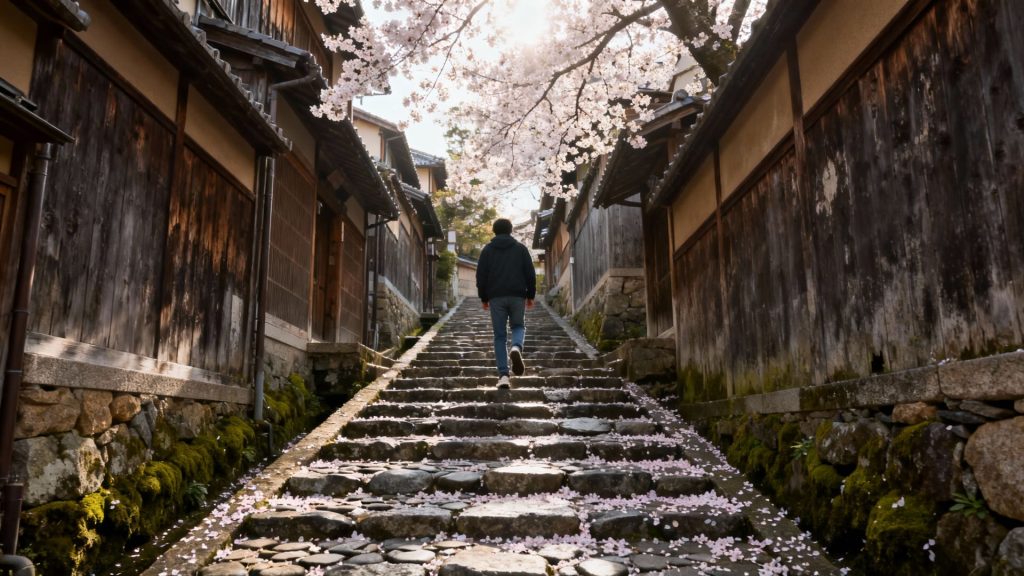
Spring arrives in Kyoto with a hushed reverence, and nowhere is this more palpable than along the Philosopher’s Path. As dawn breaks, the first blush of sunlight filters through a canopy of cherry blossoms, casting a delicate pink hue upon the stone-paved walkway. The air hums with the gentle murmur of the canal, its surface a liquid mirror reflecting the floral spectacle above. Here, time seems to suspend, and the world narrows to the rhythm of falling petals and the soft crunch of gravel underfoot.
Stretching for approximately two kilometers, the path traces the course of a shallow canal, flanked by hundreds of sakura trees. Their branches, heavy with blooms, arch gracefully over the water, creating a tunnel of ethereal beauty. Stone bridges punctuate the route, each offering a vantage point to observe the play of light and shadow on the water’s surface. In the stillness, the blossoms appear to float on the canal, their reflections forming a continuous stream of pink that drifts languidly downstream. This is a landscape painted in the softest pastels, a symphony of nature’s transience.
Named after the 20th-century philosopher who meditated here daily, the path embodies a profound connection between contemplation and nature. It is not merely a scenic route but a physical manifestation of Zen principles—simplicity, impermanence, and harmony. The stones beneath one’s feet, smoothed by centuries of use, whisper of the countless seekers who have trodden this way, each step a silent dialogue between the self and the surrounding world. The path invites introspection, urging travelers to slow down and absorb the quiet wisdom of the environment.
While spring’s cherry blossoms are the most celebrated, the Philosopher’s Path reveals a different character with each season. Summer cloaks the canal in a lush green canopy, the air thick with the drone of cicadas and the scent of damp earth. Autumn transforms the tunnel into a fiery corridor of maple and gingko leaves, their reflections burning crimson and gold on the water’s surface. Winter, perhaps the most serene, dusts the stones and bare branches with snow, reducing the landscape to monochrome elegance. Each season offers a unique meditation on the passage of time.
To fully embrace the path’s magic, visit at the cusp of dawn or dusk, when the light is soft and crowds are sparse. Listen for the subtle sounds—the trickle of water, the rustle of leaves, the distant chime of temple bells. Notice how the blossoms’ reflections shift with the breeze, creating ever-changing patterns on the canal. Pause on a bridge and observe the koi swimming beneath the floral canopy, their movements slow and deliberate. This is a place to engage all senses, to be present in the moment, and to let the landscape speak directly to the soul.
The Philosopher’s Path is more than a scenic walk; it is a journey into the heart of stillness. As travelers, we become part of its continuum, our footsteps joining those of the philosophers and poets who sought solace here. In the delicate balance between the ephemeral blossoms and the enduring stones, we find a metaphor for life itself—fleeting yet eternal, fragile yet resilient. To walk this path is to remember that beauty is not just seen but felt, a quiet echo in the chambers of memory that lingers long after the petals have fallen.