
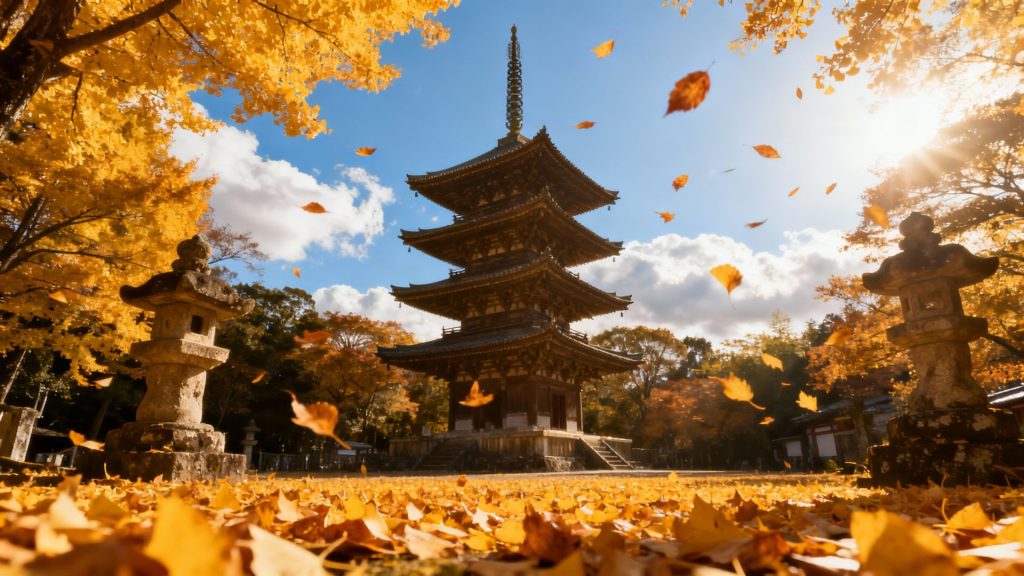
Whispers of Ancient Stones: Kyoto’s Timeless Embrace Under Autumn Skies
Where Golden Temples Reflect Centuries of Serenity, and Every Cobblestone Path Echoes with the Silent Stories of Samurai and Geishas
Dawn breaks over Kyoto with a soft, golden haze that settles like a veil upon the ancient city, the air crisp and fragrant with the scent of pine and distant incense. From the moment one steps onto the moss-covered stones of Kiyomizu-dera, the world narrows to the symphony of temple bells chiming in harmony with the rustle of maple leaves, each note a gentle invitation into a realm where time seems to pause. Here, the light filters through centuries-old wooden structures, casting long shadows that dance across stone pathways, awakening a sense of arrival not just in place, but in a shared human memory of tranquility and reverence. The city unfolds like a living scroll, its contours defined by the Arashiyama mountains in the distance, their peaks dusted with the first hints of autumn frost, while the Kamo River murmurs below, a constant, soothing undercurrent to the stillness. This initial immersion is not merely visual; it is a full-bodied awakening, where the cool touch of morning dew on skin and the distant call of a temple gong resonate deep within, pulling travelers into a narrative woven from nature’s quiet persistence and the enduring spirit of a culture that has thrived here for over a millennium.
At the heart of Kyoto’s allure lies Kinkaku-ji, the Golden Pavilion, its reflection shimmering perfectly in the mirror-like pond that cradles it, a vision of gilded serenity against a backdrop of vibrant maples and cryptomeria trees. The structure, rebuilt with meticulous care after centuries of history, stands not as a relic but as a testament to harmony between human creation and the natural world. Its walls, adorned in gold leaf, catch the sunlight in a way that transforms the entire scene into a living painting, where the play of light and shadow creates an ever-shifting tapestry of gold and green. Nearby, the Philosopher’s Path winds along a canal lined with hundreds of cherry trees, their branches arching overhead like a cathedral of nature, while the sound of water trickling over smooth stones provides a rhythmic counterpoint to the silence. This landscape is not static; it breathes with the seasons, from the delicate pink blossoms of spring that carpet the ground in a soft blush to the fiery reds and oranges of autumn that set the hills ablaze. Each element, from the meticulously raked gravel gardens of Ryoan-ji to the towering bamboo groves of Arashiyama, speaks of a design philosophy rooted in Zen principles, where simplicity and asymmetry invite contemplation, urging visitors to slow their pace and absorb the profound beauty in every detail.
Kyoto’s soul is etched into its architecture and traditions, a reflection of a culture that has long revered the balance between humanity and the environment. The city’s temples and shrines, such as Fushimi Inari-taisha with its thousands of vermilion torii gates snaking up the mountainside, embody a spiritual dialogue with the land, their structures built to withstand earthquakes and typhoons through ingenious wooden joinery that flexes rather than breaks. This resilience mirrors the enduring practices of tea ceremonies and ikebana, where every gesture is a meditation on impermanence and harmony, passed down through generations without fanfare. The narrow lanes of Gion, lined with machiya townhouses, whisper tales of geishas who once glided silently through the evenings, their artistry a living heritage that avoids the trappings of modernity. Here, history is not confined to museums; it permeates the air in the scent of roasting matcha from a hidden teahouse or the sight of a stone lantern weathered by rain and time, each element a silent teacher of patience and continuity. This cultural depth is palpable, not through grand narratives but through the subtle interplay of light on aged wood, the way a temple’s eaves frame the sky, or the echo of a shakuhachi flute from a distant garden, all of which evoke a universal longing for connection to something timeless and pure.
As the day unfolds, Kyoto reveals its chameleon-like nature, shifting hues and moods with the passage of hours and seasons. At sunrise, the eastern sky ignites behind the silhouette of Kiyomizu-dera, painting the wooden verandas in soft pinks and oranges, while the city awakens to the rhythmic clatter of wooden geta sandals on stone. By noon, the sun casts sharp contrasts, illuminating the intricate carvings of Nijo Castle and deepening the shadows of its hidden chambers, where shoguns once plotted in secrecy. Come evening, the lanterns of Pontocho Alley flicker to life, their warm glow reflecting in the Kamo River like scattered stars, as the cooling air carries the faint melody of a koto from an open window. Seasonal transformations are equally profound: in spring, the cherry blossoms bloom in a fleeting explosion of white and pink, drawing crowds to Maruyama Park for hanami picnics beneath the boughs; summer brings emerald greens and the hum of cicadas, with the Gion Festival’s vibrant parades; autumn cloaks the city in a tapestry of crimson and gold, especially along the Togetsukyo Bridge, where maple leaves drift like confetti onto the river; and winter, with its rare snowfalls, drapes the temples in a hushed, pristine blanket, turning gardens into monochrome masterpieces. This ever-changing canvas ensures that no two visits are alike, each moment a unique invitation to witness the ephemeral beauty that defines Kyoto, stirring memories of childhood wonder or forgotten journeys.
To fully embrace Kyoto’s essence, engage the senses with deliberate simplicity: walk the Philosopher’s Path at dawn, when the world is still and the only sounds are your footsteps and the rustle of leaves, allowing the cool air to cleanse the mind. Pause at a small tea house to savor a bowl of freshly whisked matcha, its bitter-sweet warmth a direct link to centuries of tradition, while the aroma of roasted green tea leaves fills the space. Visit the Arashiyama Bamboo Grove, where towering stalks create a natural cathedral, their gentle sway and soft creaks forming a symphony that resonates in the bones, and touch the smooth, cool surfaces of ancient stone statues at Ryoan-ji, feeling the weight of history in their stillness. For a deeper immersion, attend a quiet meditation session at a Zen temple, focusing on the rhythm of breath and the distant chime of a bell, or explore Nishiki Market, not for shopping but to inhale the scents of pickled vegetables, grilled mochi, and dried seaweed, each stall a sensory portal to daily life. Avoid the crowds by seeking out lesser-known shrines like Ginkaku-ji in the late afternoon, when the silver pavilion glows softly in the fading light, and let the silence guide you to a bench overlooking the sand garden, where raked patterns mimic ocean waves, inviting introspection. This practical approach transforms sightseeing into a personal pilgrimage, where every sensation— from the crunch of gravel underfoot to the taste of yudofu hot pot— becomes a thread in the tapestry of memory.
In the end, Kyoto’s true magic lies not in its monuments alone but in the quiet conversations it sparks between traveler and terrain, a dialogue that transcends language and time. Standing before the moss-covered stones of Saiho-ji, the Temple of Moss, one cannot help but reflect on the impermanence celebrated in wabi-sabi philosophy— the beauty in decay, the acceptance of change. This city, with its cycles of bloom and wither, teaches that travel is less about discovery and more about recognition, as familiar emotions surface in the curve of a tiled roof or the stillness of a koi pond. It invites us to carry a piece of its serenity home, not as a souvenir, but as a renewed perspective on our own fleeting moments. For in Kyoto’s embrace, the past is not distant; it is a living breath in the present, a reminder that the most profound journeys are those that echo within, long after the footsteps fade. Here, amidst the whispers of ancient stones, we find not just a destination, but a mirror to our own stories, where every visit becomes a gentle nudge to cherish the ephemeral and seek harmony in the everyday.