Where Golden Light Dances on Timeless Hills: A Journey Through Tuscany’s Whispering Landscapes
In the embrace of cypress-lined roads and sun-kissed vineyards, Tuscany’s ancient rhythm awakens forgotten seasons within the traveler’s soul
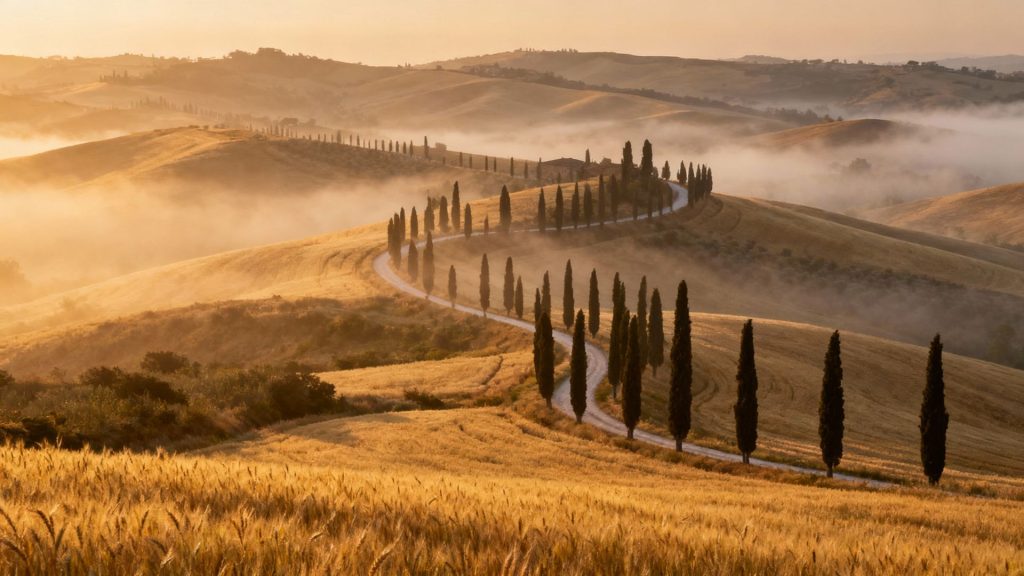
Dawn breaks over the Val d’Orcia like spilled honey, gilding the undulating hills where mist clings to olive groves in silver veils. The air carries the earthy perfume of damp soil and wild thyme, pierced by the distant chime of sheep bells – a sound unchanged since medieval shepherds tread these paths. Here, time folds upon itself; crumbling stone farmhouses stand guard over vineyards that flow like liquid emerald across the terrain. As the first rays ignite the hilltops, the entire landscape becomes a breathing canvas where every shade of green holds centuries of stories in its hue.
The soul of this land lives in the dialogue between human hands and generous earth. Dry-stone walls serpentine across slopes, built by generations past yet still containing the terraced vineyards that define the horizon. Each muscular cypress tree standing sentry along ridgelines tells of careful planning – windbreaks planted centuries ago still protecting grapevines today. The ochre-walled farmhouses aren’t imposed upon the hills but grow from them, their terracotta roofs blending into autumn’s burnt sienna palette. These structures possess a humble perfection, their window shutters faded to the exact blue of the midday sky, their courtyards embracing the same sunlight that ripens plump Sangiovese grapes.
Seasonal transformations rewrite the landscape with quiet drama. Spring arrives in explosions of crimson poppies dancing between vine rows, while summer turns wheat fields into oceans of molten gold swaying in the sirocco’s breath. Come September, the vineyards blaze with fire-colored leaves, and the harvest buzz fills the valleys with the perfume of crushed grapes. Winter strips the hills to their essential bones, revealing elegant contours beneath misty mornings when frost etches delicate patterns on abandoned ploughs. Each transitional moment feels like turning a page in some ancient agricultural manuscript where light becomes the illuminator of changing chapters.
History permeates every rock and root. Roman roads still lie buried beneath the gravel paths where tractors now rumble, while Etruscan tombs dot hidden valleys like forgotten secrets. Medieval watchtowers punctuate distant ridgelines, their crumbling stones keeping vigil over landscapes they’ve guarded for eight hundred harvests. The very dirt seems layered with memory – volcanic ash from millennia past mixing with grape pomace from last autumn’s pressing. This is not a museum but living continuity, where the spiral of a Romanesque church column echoes in the curl of a vine tendril, both reaching toward the same Mediterranean sun.
Engage all senses to discover Tuscany’s essence. Walk barefoot at twilight along chalky white roads still radiating the day’s warmth, feeling the earth’s heartbeat through soles. Crush wild fennel between fingertips and inhale its liquorice-scented defiance against stone walls. Taste the metallic tang of newly pressed olive oil on crusty bread where the bitterness carries the summer’s drought. At dusk, listen as the landscape exhales – swallows tracing arabesques overhead, the creak of ancient well pulleys, and the profound silence between the cricket songs. For the purest communion, wander the Strada del Vino between Montepulciano and Montalcino as sunset transforms every hill into a study of amber light.
Ultimately, Tuscany teaches that true belonging requires no monuments but emerges from harmony. The slow unfurling of days measured by sun angles rather than clocks, the understanding that human hands shape best when following nature’s contours. As stars pierce the inky velvet sky above a solitary farmhouse lamp, time collapses. That flicker could be a 15th-century farmer trimming his wick or a modern traveler writing journally – both united beneath the same constellations that guided Medici navigators. The landscape holds this continuity, offering modern wanderers not escape but homecoming, not nostalgia but the timeless present where every breath tastes of eternity.